
So long as you can answer a few basic questions about a gun – i.e. parts for what model are in the range bag, when was that gun last serviced, did that repair (or set of repairs) address the problem you are now noticing? – then there is little harm caused by the gun's missing manual. But having a simple filing system to record and refer to the gun's maintenance history means that you can make safe and informed decisions about a gun's use, and be in a much better position should you need to transfer a gun or have it serviced in the future.
Start with one secure home for the paper trail
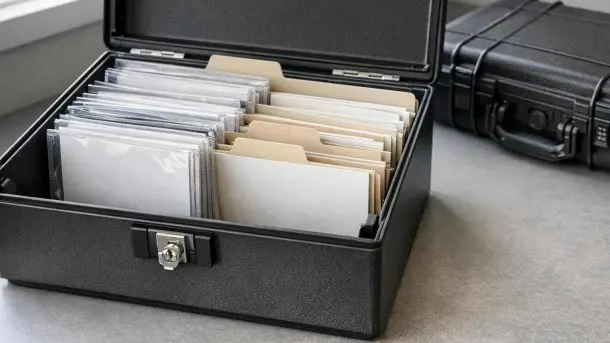
Keep all your firearm paperwork for the various firearms in your collection in one secure place. A labeled binder, document box, or even a lockable file cabinet can be a good place to start. Store the various sizes and types of paperwork in a fireproof safe for the various firearms in odd-sized folders or even scan the paperwork and store it in a secure online file storage location and mark as readable only by you.
Stained or oily documents are among the worst sort of damage that can be done to papers, and must be avoided at all costs. Ensure that service invoices, and the like, are kept behind a divider in the file, and not loose in the manual itself. Better to have to search for the extras than risk having the only copy of crucial written notes ruined by some careless spillage.
Many firearms have similar models. So, set up separate sections within your storage for similar models. Within each of these sections use simple identifiers, perhaps the manufacturer, model number, and first part of any other identifying information (i.e. serial number, model reference number). This way you can keep the outer label of your document simple and not reveal any sensitive information to casual bystanders.
Build a record that answers useful questions
Store information in a Firearms Record that will help others make sensible decisions regarding your guns. Remember to include the make, model and identifying information for each of your firearms in the Record. Include all original purchase documents and any other relevant paperwork (e.g. transfer of ownership documents) for each firearm, plus the appropriate manual and any relevant factory safety information.
Set out the date of servicing, purpose of the visit, details of the work carried out (as described by the qualified person) and any recommendations for future action (e.g. return to workshop for further work, replace component, monitor). The corresponding invoice or written report from the shop should be kept with the corresponding entry. An owner's note of any verbal explanation given by shop staff should also be made and clearly identified as such (i.e. not to be mistaken for an official shop diagnosis).
Your log might include the maintenance work that you do on a routine basis. Note cleaning and lubrication that you performed. Also note any changes you make to the storage of the firearm(s). This can be observations before and after a range session. Remember that the log is only for your information, and should not be used as a means to attempt to alter or add to the manufacturer's instructions, or those of a qualified gunsmith. When your note conflicts with the manual, or that of the gunsmith, verify the correct procedure before proceeding.
Decide what belongs on paper, in a device or both
The main benefit to paper is that it can be read without requiring a battery, for a start, and they can easily be passed to a gunsmith for a service for example. However, the disadvantages of paper are well known – it can get lost, damaged or even copied without you realizing the fact.
Digital storage also offers a host of advantages including the ability to search for information, including model numbers, within a document, as well as being able to retrieve documents such as invoices for service work long after they were created. These types of documents should be stored in reputable digital storage systems and locked behind strong, unique passwords and other forms of device protection. As with any digital data, make sure to have adequate backups stored in locations other than the original device.
The simplest way to create a backup is to keep the original documents and make a digital copy of the documents you would hate to lose. First check a document for sensitive information which you might not want to distribute. Then name your digital files in a way that does not reveal too much about the gun and its owner. Occasionally you will have to check the folder for outdated versions of manuals for certain models.
Make the file useful at the range and workshop
You keep your total Archive secure in your home. For your outings to the range you only carry whatever information you need for whatever you are going to be doing with that firearm at the range. This would typically be a manual section or two, perhaps a phone number for the service provider who worked on the gun, and a few pages of notes with questions you want to have answered about your firearms.
Before taking a firearm to the range for use review your archives for any unfinished repairs, outstanding servicing recommendations and interesting observations. Note any unusual features of the firearm and get it checked out by a gunsmith before use if they indicate possible dysfunction.
Keep manual(s) in range bag for work that needs to be referenced for particular firearm(s). Keep record of services performed with notes of any question(s) asked and work done. Verify that work has been done as described by the servicing professional. Ensure that all relevant work has been done by whoever took owner and/or service personnel.
Review the file when ownership changes
Over time an enormous amount of paperwork can be generated. Review the history of each firearm for manuals that match the gun, destroy duplicates of duplicate drafts, identify documents that relate to other firearms and mark them as such.
The absence of any paperwork does not necessarily mean the firearm is not safe, nor does a large pile of papers automatically mean that the prior owner was responsible. All available paperwork for a used firearm should be considered as part of the purchase decision and verified to the extent possible by inspection and/or proof of proper service by qualified gunsmiths.
Be sure to handle the paperwork for the sale of a gun as required by local jurisdictional authority and follow the official guidance for the transaction. As with any other document, you should retain only what you are required or need to by law and store it in a safe location. Avoid treating your gun records as if they were normal household documents.
There's nothing particularly exciting about the discipline of gun document organization necessary to maintain reference material for future safe use. Maintaining documents in a single, secure location, using one folder for each firearm and keeping dated service notes is sufficient for most gun owners. Maintain backups for reference too and you're done.